
Questioning Conventional Wisdom on Higher Education
Aug 02, 2018
As parents, we often hear about the importance of saving for college and providing a top-notch higher education for our children. We’re told a 4-year college degree is a bare minimum required in today’s job market. We feel the pressure to follow this conventional wisdom, to make sure our kids get into the best schools, so they can have the opportunity to succeed. Are we right in following conventional wisdom as it relates to the 4-year college degree as the standard for higher education?
"The only certainty about following the crowd is that you will all get there together."
Mychal Wynn
I’ve learned, unfortunately, from several failures, that it's best to avoid doing what everyone else is doing. The opposite choice in relation to the masses is often the wiser and safer one. I share the same sentiment about the typical four-year college education.
Talk to anyone and you’d be hard pressed to find someone who would disagree that a 4-year education is THE right choice. Why is that? I believe it’s because for decades we’ve been told that a college education will lead to a good job with good benefits and a successful career. Well, that’s not always true.
Now, before you think I don’t believe higher education is valuable, let me set your mind at ease. I’m a huge proponent of not just higher education but lifelong education. My concern is with the way higher education is promoted and offered today. It’s trying to fit square pegs into round holes.
What’s wrong with the 4-year bachelor's degree
1. College is not for everyone
No matter how much press and media dollars are spent to make us believe everyone should go to college, the reality is that not everyone does well when they do. Let’s look at some statistics.
-
One-third of college students drop out entirely.
-
More than half of the students enrolled in college take more than 6 years to graduate.
-
At selective universities, the on-time graduation rate is 36%.
-
At public or non-flagship universities, only 19% of students graduate on time.
For an institution that’s promoted as the “best” option for educating our future workforce, it’s hard to understand why it consistently performs so poorly.
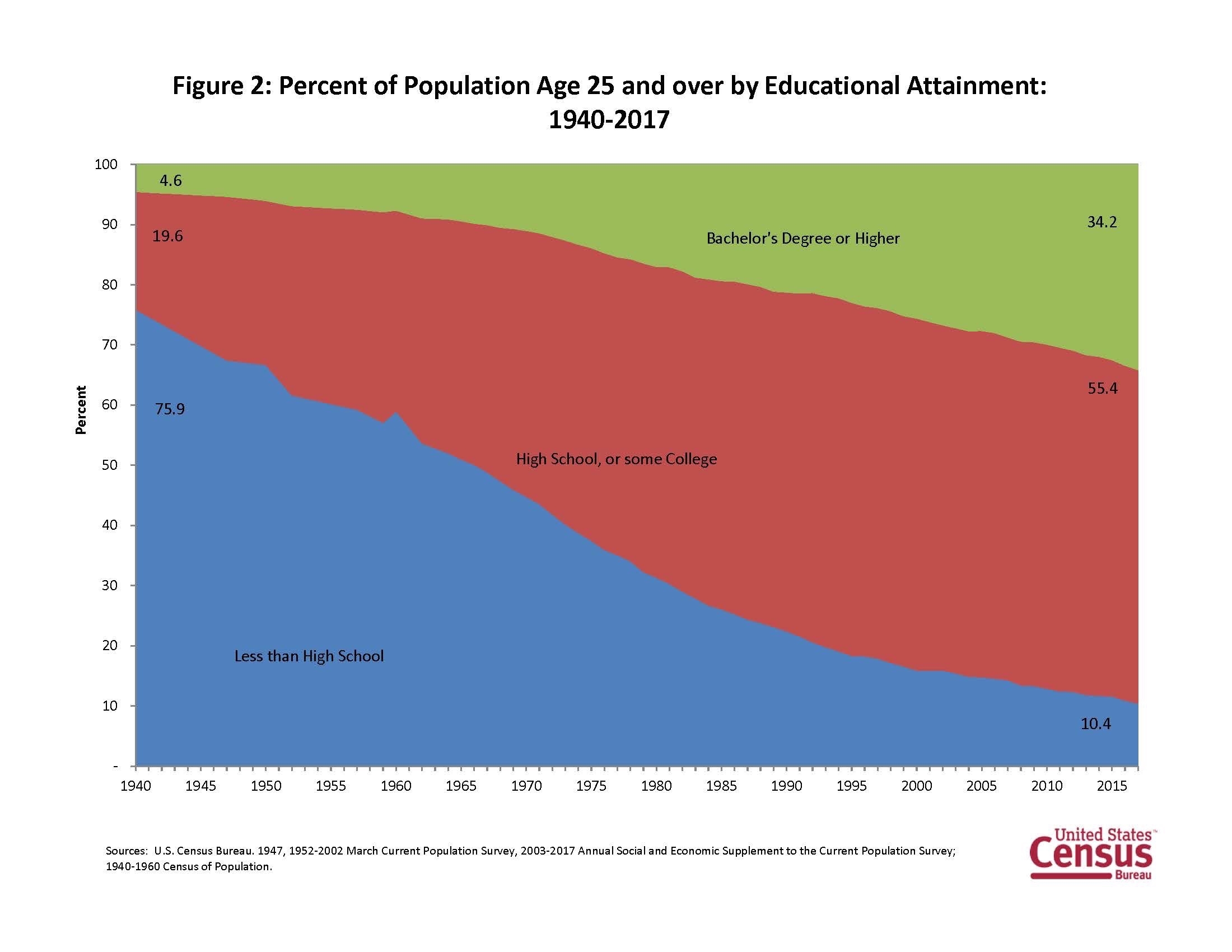
Additional evidence is provided by the Census Bureau's information on educational attainment. After all the efforts from the government, colleges and universities, and financial institutions to promote the pursuit of bachelor’s degrees, only 34.2 percent of the population over the age of 25 has actually achieved it (see chart below), but many more have attempted it.

2. College teaching methods are the least effective way to learn
Research conducted over the past few decades shows students can't take in and process all the information presented during a typical lecture. Yet, this is one of the primary ways college students are taught, particularly in introductory courses. Even when a student is able to take copious notes, he/she rarely have the time or ability to absorb the information. They learn to store information in short-term memory so they can pass the exam, but fail to truly retain the knowledge on the subject.
3. Many college majors are not marketable
There was a time when a bachelor’s degree meant something. Those who possessed them were considered to be a cut above and were given opportunities to advance quickly in their profession. That’s not the case anymore. With majors like Fine Arts, Art History, and Anthropology, employers are no longer impressed with just a college degree; they're looking for specialized and marketable skills.
Colleges and Universities should do more to ensure that students are not wasting their time and money on pursuing a path that leads to a dead end. At the least, there should be a requirement to meet with a degree specialist to ensure the student is knowledgeable and informed on what it will take to succeed. It’s foolish to assume new students understand what’s required to successfully navigate the path to the right degree for them.
4. The cost isn’t always a good investment
Getting a college degree is promoted as an investment that will pay dividends for the rest of your life. This isn’t true for everyone. Many college graduates never work in their major. In fact, according to the Census Bureau, only 27 percent of graduates take jobs that are closely related to their major.
When you take into account the cost of a 4-year degree and reflect on the student loan debt crisis, it’s difficult to argue that a college degree is a good value for everyone. There are many college-degreed baristas, waiters, and Uber drivers who would tell you otherwise.
Alternatives to higher education
If your child has not been a good student in a formal education setting, a trade or vocational school might be a better option. There are trade and vocational schools for many career fields, and the cost is a fraction of a 4-year college degree. The programs require just 1 to 2 years to complete. Many high-paying jobs can be acquired through a trade school education. Here are just a few:
-
Construction Manager
-
Aircraft Mechanic
-
Plumber, Pipe fitter, or Steamfitter
-
Electrician
-
Truck Driver (owner-operators)
-
Cosmetologist or barber
-
Realtors
Conclusion
Everyone should strive for some form of higher education, but not everyone should pursue a formal four-year college degree. There will never be a one-size-fits-all education system that works for everyone. We’re all different. Our kids are different. Help them find the path that’s natural for them. Guide and support them in pursuing the uncharted path if that’s the way they’ll find success and fulfillment.